
The production line that learns 100 million times a day: world-first AI-optimised electrolyzer manufacturing line
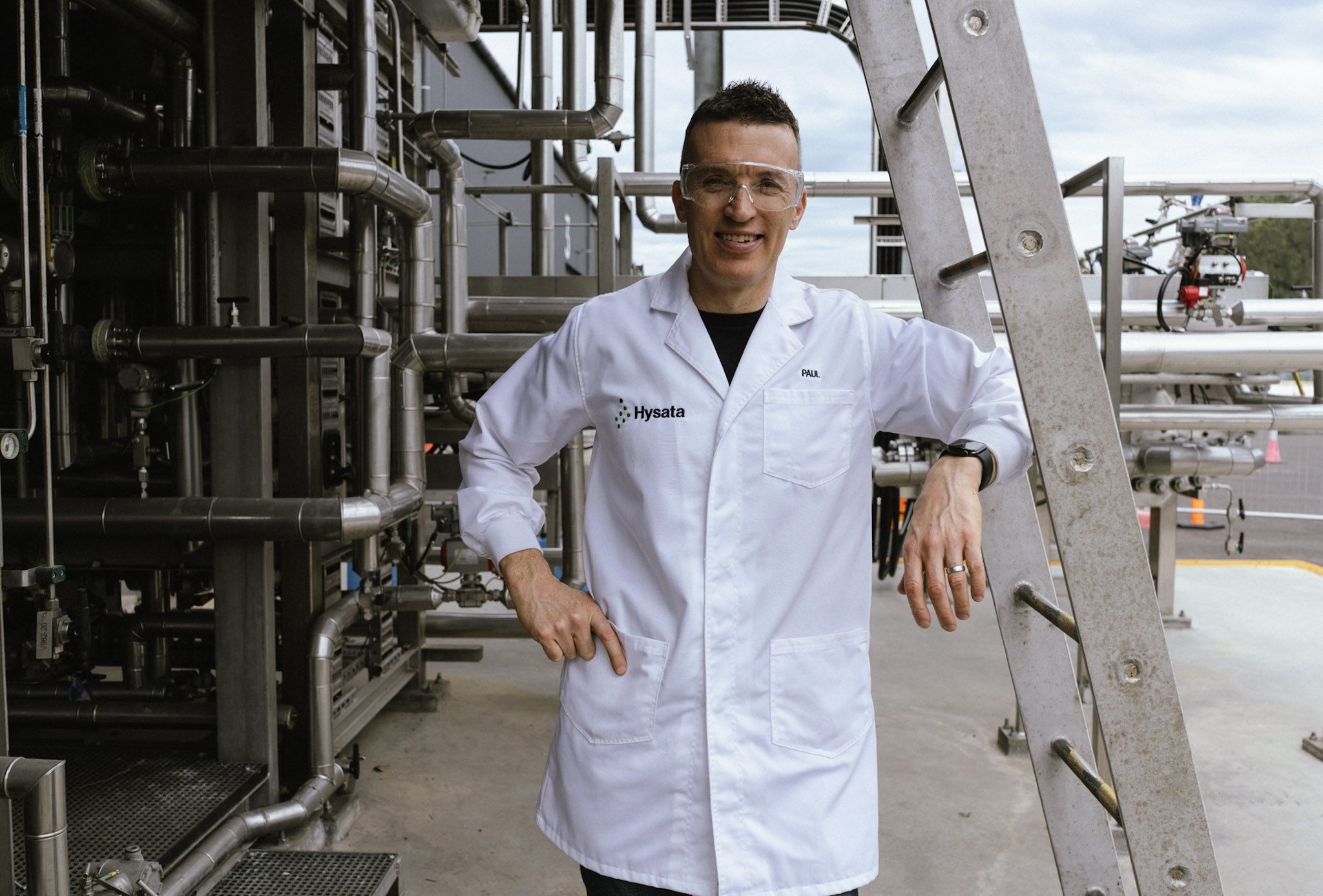
CEO Paul Barrett next to Hysata's ground breaking electrolyzer
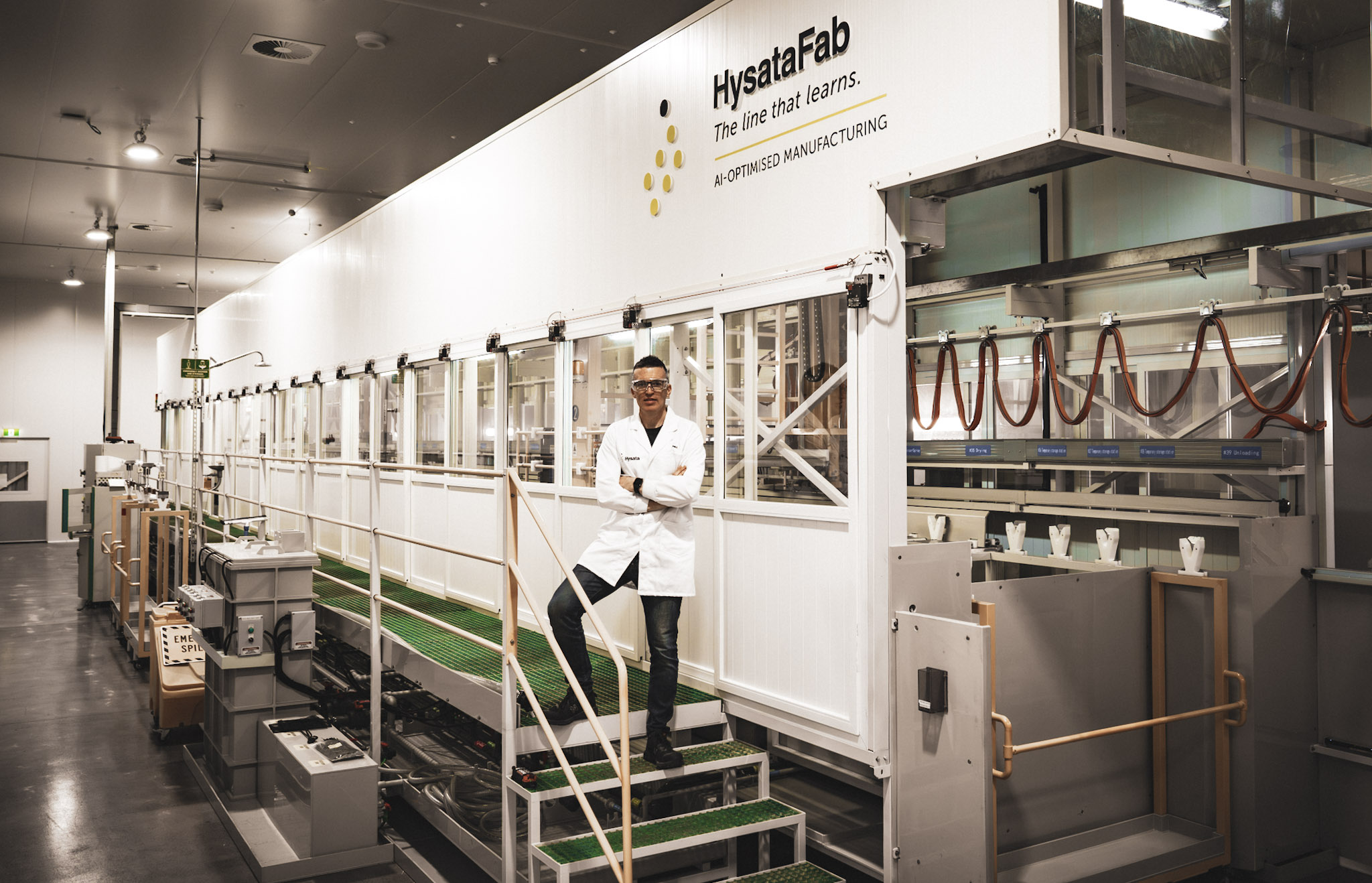
CEO Paul Barrett alongside HysataFab, the world's first AI electroylzer production line
15 per cent AI-driven production uplift lifts efficiency and cuts cost, opens a pathway to building the largest electrolyzer factory in the southern hemisphere
HysataFab uses artificial intelligence to produce up to 15 per cent more product from the same physical production line. It does this through a bespoke system integrating real-time monitoring, robotics and inline quality testing, learning from every component it makes.
HysataFab is a manufacturing platform and not a single factory.
Its first instance is a project worth close to AUD$100 million at Port Kembla, housing three production lines covering electrode, membrane, and cell and stack manufacture. Together they give the factory an initial capacity of 50MW on a single shift basis. The electrode line is open today, with membrane and cell and stack manufacture to follow. Hysata has raised more than AUD$220 million from global investors to date.
Modest additional investment would expand the factory to 200MW of capacity, making it the largest electrolyzer manufacturing facility in the southern hemisphere. Because Hysata’s system is inherently cheap to scale, HysataFab serves as a repeatable template, so as demand scales, further instances can be built towards gigawatt-scale manufacturing capacity in coming years.
Hysata Chief Executive Officer Paul Barrett said HysataFab gives the company two compounding efficiency advantages: more hydrogen per megawatt, and more product per line.
“Green hydrogen scales when the economics work, and efficiency is most of the economics,” Mr Barrett said. “We built Hysata to get more hydrogen out of every unit of electricity. We are now doing the same thing to manufacturing, getting more product out of every line.”
“More hydrogen per megawatt. More product per line. Both compound as we grow, and both are pointed at the same thing, which is cheaper hydrogen.”
How the line learns.
AI is increasingly deployed across advanced manufacturing globally to improve quality, efficiency and productivity, including in automotive, electronics and industrial production. Hysata is applying those capabilities directly to electrolyzer manufacturing, using AI not simply to automate production but to learn continuously from manufacturing data and improve the performance of the line.
Unlike conventional manufacturing automation, where operating parameters are largely predetermined, HysataFab is designed to adapt, learn and improve continuously.
HysataFab’s electrode line is the world’s first electrolyzer production line to use AI to analyse thousands of data points from every electrode it produces. Each component made helps refine the process for the next.
AI can be easily used to speed up production or tighten quality control. Hysata applies an additional test: whether AI can change the physical component itself, so that every electrode coming off the line is better than the last.
Hysata has spent three years building a digital record of how its technology behaves across research, testing and manufacturing. This record now holds more than 57 billion process data points. The business generates more than 100 million new data points every day, far beyond what any engineering team could interpret manually. Across the lab, the line and the global fleet, Hysata is using AI to turn data into a compounding advantage.
Shaun Maris, Hysata’s Principal AI Engineer, said real-time sensing and inline inspection create a digital record for every electrode.
“Every electrode has a digital fingerprint. We capture thousands of data points as it moves down the line, and the AI reads that in real time. It picks up drift before it turns into a defect, and closes the loop back into process control,” Mr Maris said.
“Our AI agents analyze more process history each day than the entire team could in a career, running close to 10,000 analytical queries daily. This is how HysataFab learns: every component produced helps optimise the next, continuously improving quality and yield.”
“There is a lot of noise about AI at the moment,” Mr Barrett said. “What interests me is whether it changes anything you can measure on a factory floor and at Hysata it does. Adding capacity is the easy part but getting more out of the capacity you already have is the harder problem, and it is the one that lowers the cost.”
Efficiency in the machine, and in the factory.
HysataFab extends Hysata’s core efficiency advantage from the electrolyzer itself into the way it is manufactured.
Hysata’s capillary-fed electrolyzer operates at 95 per cent system efficiency, or 41.5 kWh per kilogram of hydrogen. That is around 20 per cent more hydrogen per megawatt than incumbent electrolyzer technologies.
Hysata’s system is also inherently cheap to scale. A simple, modular architecture, a simplified balance of plant and reduced cooling requirements mean fewer components and lower capital cost per megawatt of manufacturing capacity. AI extends that advantage from the machine into the factory.
From breakthrough to commercial scale.
In June 2026, Hysata signed its first binding megawatt-scale export order with a global heavy-industry leader, for delivery in the first half of 2027. Electrodes for that system will be manufactured at HysataFab.
Hysata has also completed a successful field trial with ACWA Power in Saudi Arabia and holds joint development agreements with POSCO and Vestas. The company is working with tier one customers across a multi-gigawatt pipeline of bankable projects in hard-to-abate sectors.
“This is where technology leadership has to become manufacturing leadership,” Mr Barrett said. “Our customers do not buy an efficiency percentage or an AI system. They buy hydrogen economics. Our job is to use every advantage we have, in the electrolyzer and in the factory, to make those economics better at scale.”
ENDS
High resolution imagery, video and interviews relating to HysataFab can be found here in media assets
Shaun Devitt
Deviate Media
+61 400 906 451
email us here
Visit us on social media:
LinkedIn
Legal Disclaimer:
EIN Presswire provides this news content "as is" without warranty of any kind. We do not accept any responsibility or liability for the accuracy, content, images, videos, licenses, completeness, legality, or reliability of the information contained in this article. If you have any complaints or copyright issues related to this article, kindly contact the author above.
