
Femtosecond laser direct writing “guiding” Leidenfrost droplet motion
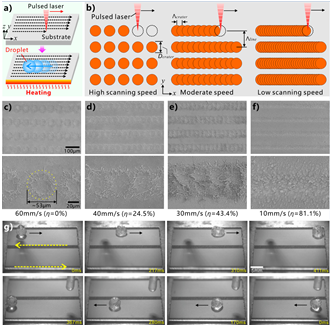
Unidirectional propulsion of Leidenfrost droplets on the femtosecond laser-structured heterogeneous aluminum surface.

Mechanism of unidirectional self-propulsion of the Leidenfrost droplets on the laser-designed heterogeneous structures.
FAYETTEVILLE, GA, UNITED STATES, May 27, 2026 /EINPresswire.com/ -- Liquid propulsion on overheated surfaces plays an important role in numerous engineering applications. Recently, Scientist in China designed a dual heterogeneous structure on an aluminum substrate via femtosecond laser direct writing and found that the heated surface could unidirectionally propel liquid droplets in the Leidenfrost state. In particular, the droplets consistently move opposite the laser processing direction, providing an ingenious strategy for the deliberate design of the motion direction and trajectory of Leidenfrost droplets.
When a liquid droplet falls onto an overheated solid surface whose temperature far exceeds the boiling point of the liquid, the droplet does not rapidly evaporate or violently splash; instead, it hovers above the hot substrate. This intriguing physical phenomenon is known as the “Leidenfrost effect”. It arises because heat-induced phase transformation at the bottom of the droplet generates a downward jet of vapor, and this vapor layer lifts the droplet. The Leidenfrost effect has found broad applications in thermal management, metal processing and welding, low-friction sliding systems, cooling systems, chemical engineering, microfluidics, and energy conversion. Its application not only enhances the efficiency and quality of industrial production but also reduces safety risks. Studies have shown that Leidenfrost droplets can achieve high-speed directional propulsion on asymmetric structures such as ratchet structures, tilted nanowires, triangular micropillar arrays, and herringbone patterns. However, these microstructures are typically fabricated uniformly on material surfaces, so that the droplets on the heated surface are either in a contact boiling state or a film boiling state. A single boiling state can only offer the advantages associated with that state, while failing to overcome its inherent drawbacks. Integrating multiple boiling states holds the promise of combining the strengths of each state.
In a new paper published in Light: Advanced Manufacturing, a team of scientists, led by Professor Dong Wu and Jiale Yong from University of Science and Technology of China and co-workers have found the directional self‑propulsion of Leidenfrost droplets on the femtosecond‑laser‑structured dual heterogeneous surface. Using a femtosecond laser, an alternating pattern of non-ablated smooth strip regions and laser-written periodic asymmetric ripple-like microstructures was designed on an aluminum surface, causing water droplets on the heated surface to enter a hybrid boiling state. The intermittent asymmetric contact boiling occurring on the peaks of these ripples generates a directional driving force, enabling directional propulsion of the Leidenfrost droplets. Interestingly, it is found that the droplets are always driven along the direction of the laser scanning line, and their motion direction is exactly opposite to the laser processing direction. By cleverly designing the laser processing path, the propulsion direction and trajectory of the Leidenfrost droplets can be flexibly controlled, enabling various functions and applications such as curved-path droplet transport, droplet expulsion, droplet trapping, targeted cooling, and droplet rotors. These scientists summarize the advantages of this laser-processing-guided Leidenfrost droplet motion technique.
“The Leidenfrost droplets on the heated sheet exhibit a hybrid boiling state: film boiling in the smooth regions and intermittent transition boiling in the ripple-like microstructures. This hybrid state combines the advantages of both the film- and transition-boiling states, achieving a balance between extended lifespan and effective heat transfer.”
“Specially, the droplets self-propel only along the laser-scanning lines and move in the direction opposite to that of laser processing, offering a programmable design strategy for flexibly controlling the motion direction and trajectory of Leidenfrost droplets.” they added.
“The study of droplet dynamics on such heterogeneous heated surfaces not only enhances the fundamental understanding of the Leidenfrost effect but also paves the way for new engineering applications.” the scientists forecast.
References
DOI
10.37188/lam.2026.068
Original Source URL
https://doi.org/10.37188/lam.2026.068
Funding Information
This work was supported by the National Key Research and Development Program of China (No. 2024YFB4610700), the National Natural Science Foundation of China (Nos. 62475251, 62325507, 52305319, and 52206223), Fundamental Research Funds for the Central Universities (No. WK2090000088), and Xiaomi Young Scholars Program.
Lucy Wang
BioDesign Research
email us here
Legal Disclaimer:
EIN Presswire provides this news content "as is" without warranty of any kind. We do not accept any responsibility or liability for the accuracy, content, images, videos, licenses, completeness, legality, or reliability of the information contained in this article. If you have any complaints or copyright issues related to this article, kindly contact the author above.
