

APRAM Aerospace about AIX Hamburg 2026: AI‑Powered Seats, Recyclable Materials, and Cabin Digitalisation
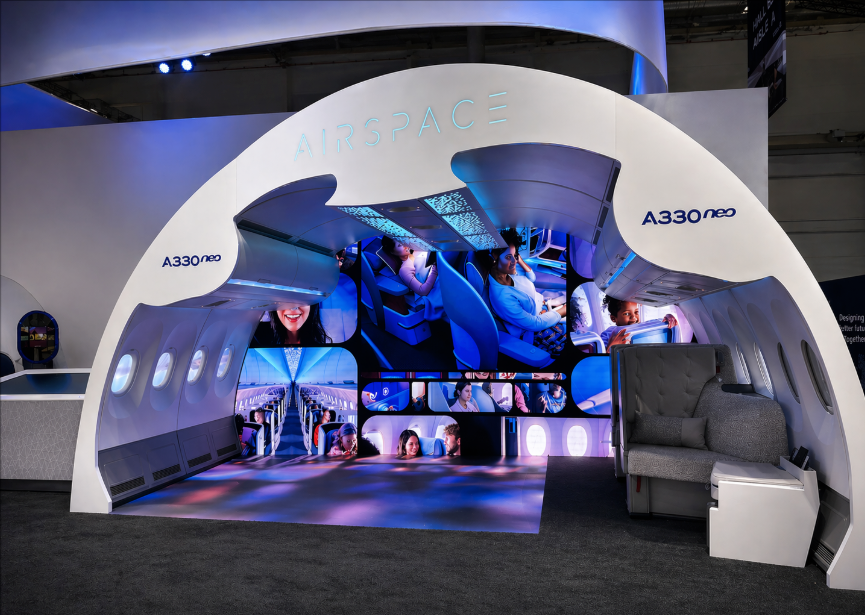
A330
From 14 to 16 April 26, Hamburg Messe hosted the 25th anniversary edition of Aircraft Interiors Expo. APRAM Aerospace was in the role of observers and partners.
The exhibition serves as an important barometer for us of what manufacturers are preparing and where the industry is heading.”
OSTRAVA, CZECH REPUBLIC, April 24, 2026 /EINPresswire.com/ -- The modernisation of narrow‑body fleets ranks among the most significant drivers of demand for consumable and repair parts on the aftermarket. "The exhibition serves as an important barometer for us of what manufacturers are preparing and where the industry is heading," explains Alena Simeckova, CEO of APRAM Aerospace.— Alena Simeckova, CEO of APRAM Aerospace
This year's edition welcomed 479 exhibitors and approximately 12,000 trade visitors, with nearly half from Europe and the remainder split between the Americas, Asia‑Pacific, the Middle East and Africa. Three thematic threads ran throughout: sustainability and the recyclable economy, digitalisation of the passenger experience, and the rising importance of business aviation.
A New Zone for Business Aviation
The standalone BizJet Interiors Zone in Hall B1 was a new feature, reflecting a market projected to grow from USD 48 billion in 2025 to nearly USD 68 billion by 2032. Business jets function as the industry's testing ground: materials, lighting, and digital interfaces debuting in luxury cabins typically reach commercial fleets within five to ten years.
AI‑Powered Seats: Narrow‑Body Modernisation in Full Swing
If this year's edition had one dominant theme, it was seating, particularly the modernisation of A320 and B737 fleets, which are key areas of focus for APRAM Aerospace. Collins Aerospace announced three launch airline customers for its new Helix economy seat, with installations planned across approximately 200 aircraft. Each such fleet renewal generates long‑term demand for associated parts, consumables, and retrofit support.
Germany's RECARO Aircraft Seating reported annual revenues of EUR 710 million and production of nearly 120,000 seats. Its R7 Horizon demonstrator for business class is roughly one fifth lighter than comparable solutions and incorporates AI‑based voice control in more than ninety languages. The R Sphere concept seat, which received the Crystal Cabin Award in the sustainability category, saves approximately 1.5 kilograms per passenger and enables modular component replacement during servicing.
French specialist Expliseat announced entry into the US market and unveiled the TiSeat S business‑class product for Embraer E‑Jet and Bombardier CRJ regional aircraft, achieving weight savings of up to forty percent. Thompson Aero Seating, Unum, and Elevate Aircraft Seating (a new Boeing brand) presented premieres for the A350 and Boeing 787.
Airspace First Class: Airbus Pushes the Boundaries
Airbus drew the most media attention with its Airspace "First Class Experience" concept for the A350‑1000, featuring a centrally positioned Master Suite for two passengers with its own lavatory, changing area, bar, and double bed. Entry into service is anticipated from 2030, as Airbus seeks to establish the A350‑1000 as its flagship long‑haul aircraft before the Boeing 777X arrives.
Cabin Digitalisation and Artificial Intelligence
The In‑Flight Entertainment and Connectivity zone hosted 77 exhibitors and showed a clear shift from closed proprietary systems toward scalable, upgradeable platforms. Thales presented FlytEDGE Aura with 4K HDR10+ Tandem OLED screens; Panasonic Avionics introduced the eXNeo system for modernising older aircraft without full hardware replacement. Rosen Aviation demonstrated Avia, a three‑dimensional AI‑powered onboard assistant capable of contextual decisions based on passenger behaviour. On the data side, ThinKom revealed a compact antenna operating simultaneously across GEO, MEO, and LEO constellations, while SES partnered with Google to standardise Android‑device connectivity to onboard Wi‑Fi.
Recyclable Materials in the Passenger Cabin
A standout exhibit was the AIM3D printer combined with ULTEM Recycle material from SABIC. The technology works directly with plastic granulate rather than filament, cutting material costs up to sevenfold. In tests with ULTEM 9085, printed parts achieve tensile strength comparable to injection‑moulded components. More significant is the closed‑loop principle: end‑of‑life cabin components are ground into granulate and reprinted into functional parts retaining original certification. For spare parts distribution, this signals growing importance of material traceability, with locally printed components potentially acquiring their own certification pathways.
The European Supply Chain Is Changing
The choice of Hamburg, the world's second‑largest aviation hub, was fitting. German manufacturers dominated this year's floor, while Chinese companies were notably absent. The only Chinese exhibitor, Hubei Hangyu Jiatai, reported post‑show contracts with VietJet, Air Arabia, Flyadeal, and Ethiopian Airlines covering over one hundred aircraft through 2030.
European consolidation was the second significant trend. Manufacturers are expanding warehouse capacity and shortening lead times, including through licences to produce American products directly in Europe. Trelleborg, for instance, will obtain a licence this year for Magee Plastic window shades and cabin panels, meaning shorter lead times and certification directly under EASA.
Many new aircraft and retrofit programmes today originate through direct OEM–airline contracts, bypassing traditional channels. For distributors, this shifts emphasis from broad portfolios toward specialisation: AOG deliveries within hours, rotable components with complete histories, consumables for specific aircraft types, and operational support during cabin refresh projects. For APRAM Aerospace, long focused on A320 and Boeing 737 fleets, this rewards specialisation, delivery speed, and proven quality processes.
What This Means for the Spare Parts Trade
Three practical conclusions emerge for APRAM Aerospace. Passenger seat renewal is gathering genuine momentum; the Collins Aerospace agreement covering two hundred aircraft is merely the tip of the iceberg, and each modernisation generates long‑term demand for associated materials and consumables. The gradual adoption of additive manufacturing is reshaping certain parts categories, with new certification pathways still taking form. And pressure on material traceability will continue to increase.
"This is absolutely essential. At APRAM Aerospace we have used a professional system since our founding, tailored precisely to the requirements of our customers and partners. All processes have been set up in great detail, and we rigorously track the provenance of every part. A customer can therefore receive documentation going back even 15 years upon request," adds Managing Director Alena Simeckova.
Over the quarter‑century chronicled by Aircraft Interiors Expo, the aircraft passenger cabin has transformed more dramatically than most other parts of the aircraft. For those of us engaged in the logistics of spare parts for the A320 and B737, these trends are not technical curiosities but factors that will define which parts, in what volumes, and with what documentation airlines will require in the years ahead.
Michal Kubicek
Mediatoring.com s.r.o.
+420 555 333 216
email us here
Visit us on social media:
LinkedIn
Legal Disclaimer:
EIN Presswire provides this news content "as is" without warranty of any kind. We do not accept any responsibility or liability for the accuracy, content, images, videos, licenses, completeness, legality, or reliability of the information contained in this article. If you have any complaints or copyright issues related to this article, kindly contact the author above.
