

Global Thermal Interface Materials Market Outlook: Asia-Pacific Leads Electronics & EV Growth with 3M, Henkel & Dow
Thermal Interface Materials Market
Navigating the High-Stakes Thermal Interface Materials Landscape: A Strategic Blueprint for Decision Makers
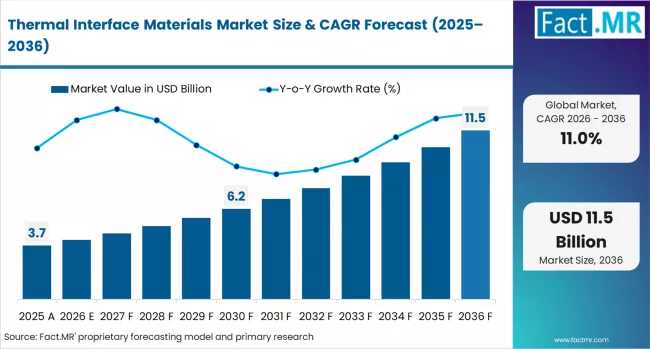
ROCKVILLE, MD, UNITED STATES, March 31, 2026 /EINPresswire.com/ -- The global Thermal Interface Materials (TIM) market is undergoing a seismic shift, driven by the concurrent explosions of Electric Vehicle (EV) adoption and Generative AI data center buildouts. Valued at USD 3.66 billion in 2025 and projected to reach USD 11.54 billion by 2036—exploding at a compound annual growth rate (CAGR) of 11.0%—this sector has transcended its status as a commodity component to become a critical enabler of next-generation technology.For procurement executives, thermal engineers, and strategic planners, navigating this rapidly evolving landscape requires a shift from transactional sourcing to strategic partnership. The complexity of modern thermal management—where EV battery energy densities are skyrocketing and AI accelerator chip power budgets are shrinking—demands a sophisticated understanding of the underlying material science, supply chain dynamics, and regulatory forces.
For Details Deep insights, Please Request A sample report for Free: https://www.factmr.com/connectus/sample?flag=S&rep_id=879
This analysis, based on critical data from Fact.MR, provides the essential intelligence needed to make informed investment and procurement decisions in this high-growth, high-stakes market.
The New Baseline: Why 5 W/mK is the Sourcing Rubicon
The single most critical takeaway for decision-makers in 2026 is the rapid escalation of performance requirements. Fact.MR’s analysis makes it clear: suppliers lacking gap-filler formulations with thermal conductivity ratings above 5 W/mK face exclusion from the EV battery pack contracts.
These contracts represent the largest emerging volume category in the TIM market. EV battery pack designers, tasked with maintaining cell temperature uniformity across modules during fast-charging cycles, are mandating lower thermal resistance thresholds at the cell-to-cold-plate interface.
Strategic Implication: TIM producers must invest in high-conductivity filler loading technology to qualify for these mission-critical applications. For OEMs, validating that a supplier can deliver these ratings at production-scale dispensing volumes is a critical step in supplier qualification.
Mitigating the Filler Supply Risk: The Alumina/Boron Nitride Bottleneck
The structural surge in demand is placing unprecedented strain on the raw material supply chain, particularly for high-performance fillers like boron nitride and alumina. This creates a significant risk for electronics and automotive OEMs who adhere to single-source material specifications.
As competitive demand from automotive and data center segments intensifies, filler supply allocation cycles are inevitable. A production disruption at a single TIM formulator could ripple through entire global supply chains.
Executive Action Plan:
EV Battery Pack Designers: Qualify at least two independent thermal interface material sources per module design.
Data Center Hardware Architects: Benchmark thermal pad compression and reliability performance across multiple suppliers before committing to server generation specifications. These decisions often lock in material selections for multi-year production programs.
TIM Formulators: Develop diversified sourcing strategies for niche compounds like boron nitride and graphene to ensure continuity of supply for your highest-performing lines.
Where the Growth Lies: Segment & Regional Opportunities
The absolute dollar opportunity between 2026 and 2036 is massive, totaling approximately USD 7.48 billion. Understanding where that capital will flow is key to strategic positioning.
By Type: The Preeminence of Pads
The pads type is projected to hold a commanding 42.0% market share in 2026. This segment is thriving due to its user-friendliness: pre-formed, solid materials are ideal for high-throughput assembly processes in both consumer electronics and EV manufacturing. They offer low pump-out or dry-out risk during the thermal cycling inherent in battery modules and power inverters, ensuring long-term operational stability.
By Application: The Automotive Juggernaut
The automotive application is the leading revenue-generating segment, forecast for an 8.4% CAGR. TIMs are now non-negotiable for heat management in battery modules, onboard chargers, and power control units. With EVs requiring components to operate within narrow temperature windows to maintain safety and lifespan, thermal control is no longer an ""add-on""—it's foundational.
By Region: China Sets the Pace
While all major consuming regions are seeing accelerated deployment, Asia is the clear growth engine.
China: Leads the global market with a projected 12.5% CAGR from 2026 to 2036, driven by its status as a manufacturing hub and massive government push for EVs.
South Korea: Follows closely with an 11.2% CAGR, leveraging its advanced semiconductor and electronics industrial base.
India: Identified as the fastest-growing thermal interface materials industry, creating a lucrative opportunity for first-movers.
In the West, the USA (10.5% CAGR) and Germany (9.5% CAGR) are robust markets, fueled by robust electronics/automotive sectors and strong research infrastructures, though they face challenges from regulatory complexities and supply chain uncertainties.
The Competitive Field: Consolidation and Co-Development
The TIM market is concentrated, with major players like Dow Chemical Company (20%-25% share), DuPont (15%-18%), 3M (15%-18%), Honeywell International (10%-12%), and Henkel AG & Co. (10%-15%) dominating through robust portfolios and strategic presence.
For instant access to this report, click "Buy Now" or connect with our analyst for customization: https://www.factmr.com/checkout/879
The strategy of these leaders is twofold:
Aggressive R&D: Investing heavily in creating innovative TIMs specifically for the EV, AI, and aerospace markets.
Deepened Partnerships: Forming co-design alliances with OEMs to bespoke products that solve specific, high-stakes operational issues.
This landscape presents an opening for strategic investors. Due to the capital-intensive nature of the R&D pipeline, there is growing opportunity for M&A to consolidate technology providers and formulators into stronger, diversified entities.
A Comprehensive Deep Dive into the Thermal Interface Materials Market
This executive summary provides critical strategic insights, but the complete 117-page report, ""Thermal Interface Materials Market: Global Industry Analysis 2026-2036,"" contains the granular data needed to build your multi-year strategy.
Pipeline Thermal Insulation Material Market https://www.factmr.com/report/1410/global-pipeline-thermal-insulation-materials-market
Thermal Transfer Overprinter Market https://www.factmr.com/report/2392/thermal-transfer-overprinter-market
Thermal Papers Market https://www.factmr.com/report/2487/thermal-papers-market
Thermal Energy Flow Meter Market https://www.factmr.com/report/2872/thermal-energy-flow-meter-market
Liquid Thermal Interface Materials Market https://www.factmr.com/report/3085/liquid-thermal-interface-materials-market
S. N. Jha
Fact.MR
+1 628-251-1583
email us here
Legal Disclaimer:
EIN Presswire provides this news content "as is" without warranty of any kind. We do not accept any responsibility or liability for the accuracy, content, images, videos, licenses, completeness, legality, or reliability of the information contained in this article. If you have any complaints or copyright issues related to this article, kindly contact the author above.
