

Demand for Gluten-Free Prepared Food in the UK Market Valuation, ROI Potential & Long-Term Growth Prospects 2026–2036
Demand for Gluten Free Prepared Food in the UK
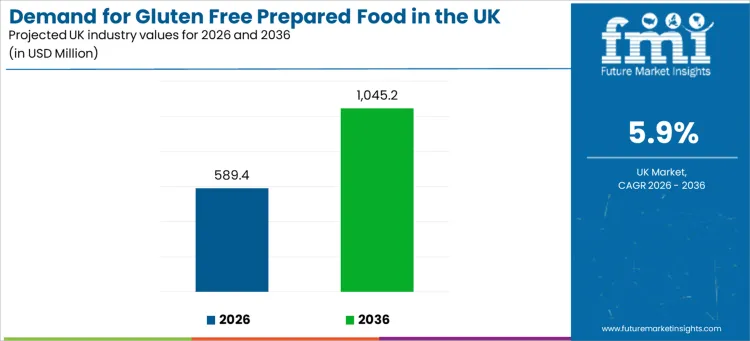
MD, UNITED STATES, January 21, 2026 /EINPresswire.com/ -- The United Kingdom gluten-free prepared food market is experiencing sustained expansion, driven by increasing diagnoses of coeliac disease and gluten sensitivity. According to a comprehensive analysis by Future Market Insights, the market is valued at USD 589.4 million in 2026 and is forecasted to reach USD 1,045.2 million by 2036, reflecting a compound annual growth rate (CAGR) of 5.9%. This growth underscores a shift toward reliable, everyday dietary solutions that prioritize consistency, allergen safety, and integration into routine lifestyles.
The report highlights how prepared gluten-free foods are addressing practical consumer needs, moving beyond discretionary choices to essential options for those with medical requirements. In a landscape where health-driven dietary adjustments are becoming normalized, these products offer shelf stability and seamless meal incorporation, ensuring users can maintain structured routines without compromise.
Market Drivers: Health Diagnoses and Retail Normalization Fuel Demand
The primary catalysts for this market's growth include a rise in clinically diagnosed coeliac disease and gluten sensitivity cases, which necessitate dependable meal solutions. Consumers are increasingly seeking products that match the taste, texture, and satiety of conventional foods, supported by rigorous gluten control measures and consistent quality outcomes.
Retail and foodservice channels play a pivotal role in this normalization. Supermarkets, holding a dominant 55.0% market share, have integrated gluten-free options into mainstream aisles, enhancing accessibility and reducing the perception of dietary separation. This strategic placement facilitates routine purchasing, aligning with broader industry efforts to meet compliance standards and consumer expectations.
Data from the analysis indicates that health perceptions linking gluten avoidance to improved digestive wellbeing are extending product trials. Clear labelling and targeted promotions further encourage adoption, particularly as formulation innovations address clean-label demands and enhance sensory appeal.
Key Challenges in the UK Gluten-Free Prepared Food Sector
Despite positive momentum, the market faces notable hurdles. Price premiums for gluten-free items compared to standard equivalents remain a barrier, though these are often offset by perceived health benefits and superior quality. Quality inconsistencies, such as drier textures in bakery products or denser ready meals, can deter repeat purchases if they fail to meet sensory benchmarks.
Cost sensitivity among consumers also influences market dynamics, with value alignment being crucial for sustained loyalty. The report emphasizes that overcoming these challenges requires ongoing investment in ingredient innovation and manufacturing processes to achieve taste parity and affordability.
Segmentation Insights: Drinks and Supermarkets Lead the Way
The UK gluten-free prepared food market is segmented by product type, sales channel, and region, providing granular insights into consumption patterns.
By Product Type
Drinks: Commanding a 40.6% share, this category benefits from easy substitution, low preparation requirements, and stable shelf life, making it ideal for broad consumption occasions.
Bakery Products: Focus on overcoming traditional quality limitations to appeal to daily users.
Ready to Eat Products: Emphasize convenience for time-constrained lifestyles.
Bread and Rolls: Address core staples with improved textures.
Pasta: Cater to meal versatility with gluten-free alternatives.
By Sales Channel
Supermarkets: With 55.0% dominance, they serve as the primary access point due to scale, visibility, and predictable distribution.
Grocery Stores: Support localized purchasing needs.
Health or Natural Food Stores: Target niche, health-focused shoppers.
Drug Stores: Offer convenient, on-the-go options
By Region
Regional variations reveal England's leadership with a 6.5% CAGR, attributed to manufacturing clusters and private label expansions. Scotland follows at 5.8%, driven by stable branded meal adoption, while Wales (5.4%) and Northern Ireland (4.7%) show measured growth through cost-aligned launches and supply stability.
These segments illustrate the market's emphasis on practicality, with ambient, chilled, and frozen formats integrating into everyday usability.
Competitive Landscape: Focus on Transparency and Reliability
The competitive environment in the UK gluten-free prepared food market is defined by commitments to ingredient transparency, allergen control, taste equivalence, and robust supply chains. Leading players are prioritizing certified manufacturing and retail penetration to differentiate their offerings.
Key participants include:
General Mills Inc.: Leveraging established brands for widespread grocery presence.
B&G Foods: Specializing in shelf-stable and frozen convenience options.
Udi’s Healthy Foods: Delivering bakery-style products that align with consumer expectations.
Enjoy Life Foods: Providing allergen-free snacks for those with strict dietary restrictions.
Ener-G Foods: Focusing on specialist items tailored to coeliac needs.
Differentiation strategies center on affordability and mainstream channel integration, ensuring products meet the demands of a growing health-conscious demographic.
Request for Sample Report | Customize Report |purchase Full Report -https://www.futuremarketinsights.com/reports/sample/rep-gb-31661
Future Outlook: Sustained Expansion Through Innovation
Looking ahead, the UK gluten-free prepared food market's 5.9% CAGR through 2036 signals a maturing sector where reliability trumps fleeting trends. As consumer preferences evolve toward clean-label and health-aligned products, industry stakeholders are investing in R&D to refine formulations and expand category penetration.
This steady growth trajectory positions the market as a key component of the broader food industry, responding to demographic shifts and medical necessities. Analysts anticipate continued regional disparities, with England's accelerated expansion highlighting opportunities in urban and manufacturing hubs.
The analysis underscores the importance of data-backed strategies, with 40.6% drink segment dominance and 55.0% supermarket share reflecting consumer priorities for accessibility and minimal quality variation.
Explore More Related Studies Published by FMI Research:
Disposable Laparoscopic Instruments Market-https://www.futuremarketinsights.com/reports/disposable-laparoscopic-instruments-market
Corneal Ulcer Treatment Market-https://www.futuremarketinsights.com/reports/corneal-ulcer-treatment-market
IV Pole Market-https://www.futuremarketinsights.com/reports/iv-poles-market
Radiopharmaceutical Market-https://www.futuremarketinsights.com/reports/radiopharmaceuticals-market
Intraosseous Infusion Devices Market-https://www.futuremarketinsights.com/reports/intraosseous-infusion-devices-market
About Future Market Insights (FMI)
Future Market Insights, Inc. (FMI) is an ESOMAR-certified, ISO 9001:2015 market research and consulting organization, trusted by Fortune 500 clients and global enterprises. With operations in the U.S., UK, India, and Dubai, FMI provides data-backed insights and strategic intelligence across 30+ industries and 1200 markets worldwide.
Why FMI: Decisions that Change Outcomes- https://www.futuremarketinsights.com/why-fmi
Contact Us:
Future Market Insights Inc.
Christiana Corporate, 200 Continental Drive,
Suite 401, Newark, Delaware – 19713, USA
T: +1-347-918-3531
Website: https://www.futuremarketinsights.com
LinkedIn| Twitter| Blogs | YouTube
Have a specific Requirements and Need Assistant on Report Pricing or Limited Budget please contact us - sales@futuremarketinsights.com
Sudip Saha
Future Market Insights Inc.
+ +1 347-918-3531
email us here
Legal Disclaimer:
EIN Presswire provides this news content "as is" without warranty of any kind. We do not accept any responsibility or liability for the accuracy, content, images, videos, licenses, completeness, legality, or reliability of the information contained in this article. If you have any complaints or copyright issues related to this article, kindly contact the author above.
